Recent research conducted by a team of Israeli scientists demonstrates how plants would be able to listen despite not having ears.
Researchers at Tel-Aviv University have discovered that plants can indeed feel the buzzing of bees in passing, reacting to this sound by producing a sweeter nectar. Acting as sensory organs would not be actual ears but the flowers themselves.
The Oenothera drummondii plant
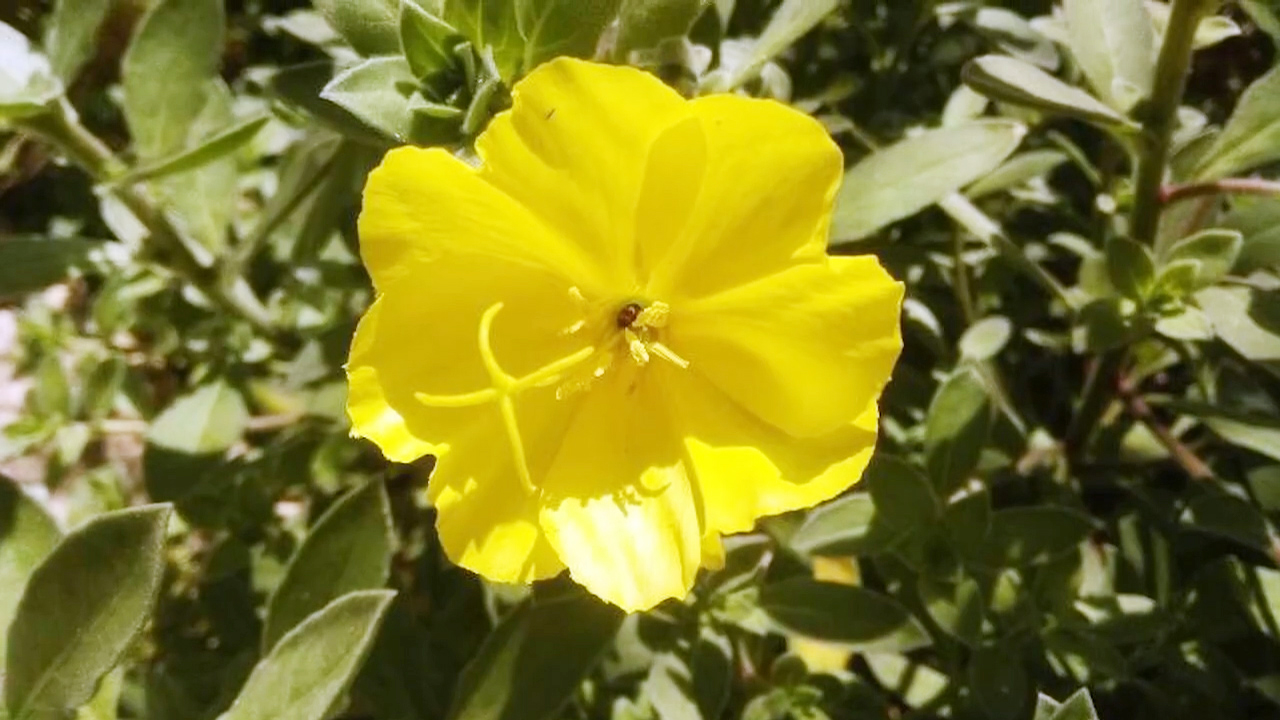
The plant under observation is Oenothera drummondiia perennial herbaceous plant that takes its name from Thomas Drummond, a Scottish naturalist who lived in the early 1800s. This species, native to Texas, presents nectariferous flowers yellow bell-shaped. The fruits are dehiscent capsules containing numerous seeds. Its characteristics of great rusticity and adaptability have facilitated its rapid diffusion on the main coastal areas of the globe characterized by the presence of sand dunes. They can also be found in abundance on the southern coasts of the Mediterranean basin. The flower is made up of four petals and opens in the evening hours. Its main pollinators are some moths (especially at night and in the early hours of the morning) and bees (at dusk and in the morning).

A flower that hears bees
Dr. Lilach Hadany, Yuval Sapir, Yossi Yovel and the Israeli research team carried out tests on more than 650 flowers of Enotherafound in abundance on the dunes of Beit Yanai. The tests were conducted both in the external environment and in the laboratory, using advanced techniques such as laser vibrometry. From the experiments conducted it emerged that three minutes after being exposed to the buzz of a bee in flight, the flowers began to produce a sweeter nectarwith a sugar concentration 20% higher than usual.
The same reaction is obtained by subjecting the flowers of Enothera A artificial acoustic signals with the same frequencies of the sound emitted by bees in flight while vibrations at different frequencies are ignoredinduced for example by the wind, demonstrating how this plant was able to filter the noises it picked up, discarding frequencies that were not correlated with the presence of pollinating insects.
For the first time it was possible to document that plants can rapidly respond to the sounds of pollinators in an ecologically relevant way.
Starting hypothesis and experiment
The hypothesis that scientists investigated is that plants can actually pick up the vibrations of sound waves using the flower as an auriclewhose concave shape would help the perception of sounds.
The experiments measured nectar production on Oenothera flowers in response to different types of sound: silence, recordings of a bee 10 centimeters away, and computer-generated sounds at low, intermediate and high frequencies.
The plants placed under glass bells in order to soundproof the environment did not show significant variations in the sugar concentrations of the nectar, as did those subjected to intermediate (34-35 kilohertz) and high (158-160 kilohertz) frequencies.
Plants exposed to recordings of bee buzzes (0.2-0.5 kilohertz) and other low frequencies close to that sound (0.05-1 kilohertz) instead responded in 3 minutes by increasing sugar concentrations within the nectar.
Further laboratory tests
To ascertain whether the flower was indeed the sensory organ involved, Hadany and her co-author Marine Veits placed the Enothera in a specific machine called a laser vibrometer, capable of detecting and measuring minimal movements. Subjected to the recorded sound of a bee in flight, the flower petals vibrated with the same wavelengths of sound treatments.
During the experiments, to confirm that the structure of the flower was responsible, some flowers that were missing one or more petals were also tested. These flowers did not produce any change in nectar production, which would suggest the plausibility of the mechanism by which the flower acts as the auditory sensory organ of the plant.
Competitive advantages
“Plants have many interactions with animals, and animals make and hear noises“team member Lilach Hadany told Ed Yong to the Atlantic. Based on this, it would be strange if the plants do not try to align themselves take advantage of this ingenious mechanism. In fact, producing sweeter nectar means that the bees could continue to feed for longer, increasing both the possibility that the insects will collect the pollen and then return to feed on the flowers of the same species. In field observations, the researchers found that pollinators were nine times more common around plants that another pollinator had visited in the previous six minutes.
All of this promotes cross-pollinationessential for the flower’s ovules to be pollinated with genetic material from another individual of the same species. This allows genetic enrichment and the potential emergence of improving traits.
Furthermore, this relationship between sound and nectar production is well calibrated, because the plants must be sure that it is worth increasing the sweetness and that they are not resources used in vain. Water and sugars are scarce resources, especially in arid environments where Oenothera drummondii it usually grows: optimizing its use is a great advantage for the plant.
Further implications
The potential of this discovery has barely been scratched, so much so researchers’ questions increasewondering in how many other fields these vibrations can be useful to plants.
A second study, resulting from the interesting results achieved by the Israeli team, now investigates a more active side of bioacoustics: plants in fact emit soundsimperceptible in volume and frequencies to humans but probably audible to insects and other animals. This could be useful for plants to attract animals involved in seed dispersal or to signal their health status to nearby plants, the arrival of a herbivorous predator or a parasite. The first experiments conducted on tomato and tobacco plants appear to be encouraging.
“We must take into account that flowers have evolved with pollinators for a long time“,”They are living beings and they too need to survive in the world. It is important for them to be able to perceive their environment, especially if they can’t go anywhere“Says Hadany.
It often happens that you see plants that they react to various types of light or touchnow it is also possible to add acoustic vibrations.
Small curiosity, the common English name ofOenothera drummondii And Evening primroseevening primrose, the same as a famous musical based on the story by John Collier. For a plant that feels it couldn’t be otherwise.
In Italy the species Oenothera biennis is much more widespread, where it grows spontaneously in marginal areas, on roadsides and in uncultivated areas, raising yellow flowers

Latest Posts Published

care and maintenance » Le Georgiche Nurseries

care and maintenance » Le Georgiche Nurseries

Here’s what work needs to be done

June 1st – Children’s Day: history, meaning and special gifts

How to decorate for Easter?

10 simple ways to «tidy up» your home

Mountain Banana (Asimina triloba): how to grow it and enjoy its rare fruits

Innovative storage and organization solutions for a more airy space

Find inspiration to decorate with wallpaper and stickers in your own personal style.